Patient Education Library
Educational signposts to guide you from the confusion of the crash site back to your driveway.
Or start from a symptom
The road back
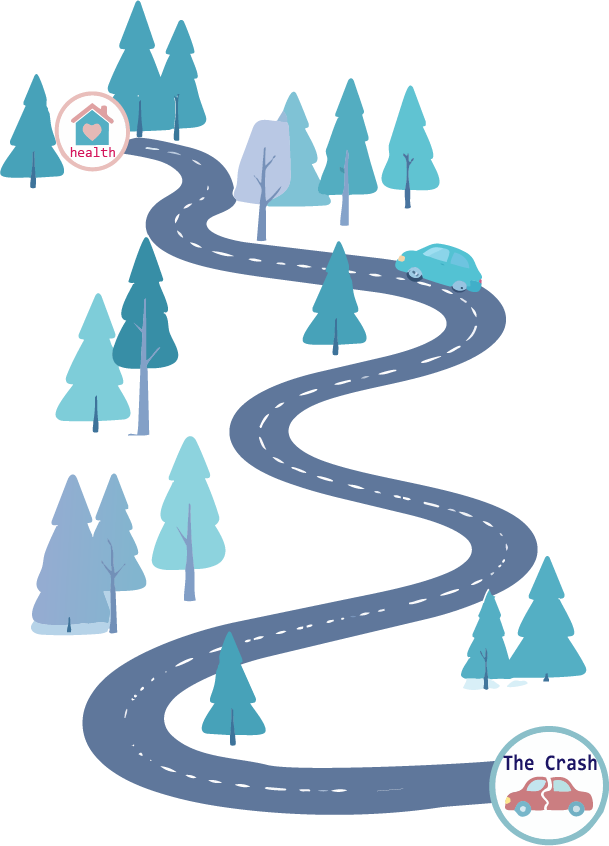
If you would rather begin with what you are actually feeling, start at The Crash in the lower right and follow the road up toward health. Every label is a guide you can read.
Pick the symptom you woke up with, or the treatment someone has already offered you, and start with that guide instead.
- What you might be feeling
- What helps along the way
What you might be feeling
Phase 1 of 4 · Foundation
The big picture
Why pain persists after the tissues have healed, and why the nervous system has as much to do with recovery as the injury did.
The Mind-Body Connection
An explanation of why pain can continue after a motor vehicle accident. Covers pacing, early movement, soft-tissue care, and how calming the sensitized nervous system supports strength, mobility, and confidence.
Read the guideThe Mind-Body Disconnect
Integrating neurobiology and physical medicine to explain how whiplash, concussion, and the protective alarm system drive persistent symptoms. Explores sensory mismatch, amygdala activation, and the path to restoring coherence.
Read the guideMind-Body-Spirit Deep Dive
A deeper look at how trauma changes muscle tone, autonomic balance, sleep, breathing, and threat perception, and how coordinated physical and psychological care rebuilds a sense of safety and control.
Read the guideWhy the Other Driver Rarely Hurts
Why injured patients often struggle more than at-fault drivers. Reviews loss of control, perceived injustice, system stress, and how these factors amplify pain.
Read the guidePhase 2 of 4 · Understanding
What's going on in there
Referred pain is the reason a crash in your neck can be felt in your arm. These guides explain the patterns behind symptoms that do not seem to match the injury.
Myofascial Pain Referral
An introduction to referred muscle pain with examples. Explains why pain travels, which patterns are common, and basic strategies for relief.
Read the guideWhiplash & Hydrostatic IMS
Why whiplash leads to persistent myofascial patterns and how Hydrostatic IMS compares with dry needling and trigger point injections.
Read the guideCommon Trigger Points After MVA
An overview of muscle patterns commonly irritated in collisions. Shows where they refer pain, how they can mimic other conditions, and which treatments can help.
Read the guideRegional deep dives
Four places that account for most of the confusing pain after a collision.
The Iliacus & Psoas
How deep hip flexor spasm develops after collisions, especially with height-mismatched impacts. Describes psoas-SI interaction and the role of targeted anterior work.
Read the guideThe Sacroiliac Joint
A review of post-MVA sacroiliac joint pain patterns. Explains how vertical shear loads irritate the SI joint and how to distinguish SI pain from disc-related pain.
Read the guide"Degenerative Disc" Pain
An explanation of age-related disc findings, what MRI terms actually mean, and how myofascial sources can imitate disc pain.
Read the guideHerniated Disc Deep Dive
Why true herniated discs are rare in MVAs, the limits of epidural steroid injections, and why conservative care is the gold standard.
Read the guidePhase 3 of 4 · Clarify
Getting a real answer
When the picture is unclear, objective testing separates nerve injury from muscle pain — and tells everyone treating you what they are actually treating.
EMG/NCV Testing
An overview of how EMG and nerve conduction studies separate nerve injury from muscle pain. Explains what the test measures and how results guide treatment.
Read the guideSensory Mapping
A detailed explanation of a sensory-mapping approach to post-traumatic pain: how to identify primary drivers, separate muscle from nerve sources, and understand sensitization.
Read the guidePhase 4 of 4 · Recovery
Getting back to normal
Once the pattern is stable, the work turns to rebuilding what the injury took: strength, endurance, and confidence in your own body.
Take it with you
Printable handouts
Print-friendly guides for the fridge, the physical therapist, or the next appointment. Several are two-sided.
Beyond the clinical
Essays & reflections
Short pieces about art, physics, osteopathy, and the long attempt to heal — written between patients.