
Car Accident Doctor in Edmonds, WA
Physician-led evaluation and treatment after a collision, from the first painful week to full recovery
P: (425) 678-2044 soundinjury.com
The Car Accident Injury Core Mismatch
A collision does not injure one system. In the same fraction of a second it strains tissue, it switches on a protective alarm, and it disrupts how the brain processes vision, balance, and concentration. Nearly everyone arrives because of the first one. The other two usually go unmentioned, and they are the reason recovery stalls.
The three feed each other. Tight muscles keep the alarm on. The alarm keeps the muscles tight. An overloaded brain makes both worse. For you to feel stable, all three have to agree, and after a crash they stop agreeing.
BODY
Trigger points, the sacroiliac joint, strained tissue, irritated nerve roots. Real and treatable, and the only leg most people bring up.
ALARM
The threat system stays switched on after the crash. It raises muscle tone, amplifies pain, and wrecks sleep. Treating muscle while the alarm blares undoes the work.
BRAIN
Vision, inner ear, and focus stop lining up. The scan is normal, so the conversation ends. A normal scan means nothing is broken, not that the system is working.
What I See Most Often After a Crash
Ordered by how frequently these show up in my clinic, not by severity. Any one of them can be the thing that keeps you stuck.
Myofascial Pain and Trigger Points Body
What is happening: The way I think about it, a trigger point is a form of dystonia: a muscle stuck in sustained involuntary contraction because the conversation between the muscle and the nervous system that regulates it has broken down.
Muscles do not set their own tension. Spindles buried inside each muscle report length and stretch up to the spinal cord and brain, and the nervous system continuously sets how tightly to hold and how sensitive those spindles should be. It is a conversation running in a loop, thousands of times a second, entirely beneath awareness.
A collision breaks the conversation. The muscle clamps down to protect you. The clamped muscle restricts its own blood supply. The resulting pain feeds back up the loop as a threat signal, and the nervous system answers the only way it knows how: hold tighter. Spasm produces pain, and pain produces spasm.
Two other systems lean on that loop and make it worse. A nervous system still braced for impact (the alarm) raises resting muscle tone across the board. And when vision, the inner ear, and neck position stop agreeing with each other, the nervous system stiffens the whole frame to keep you upright. This is why the trigger point is not really a "muscle problem." It is where all three legs of the stool meet.
That single dysregulated loop then produces three different problems, which is why it causes so much confusion:
- Local pain. The band itself hurts, and it stays sore because a contracted muscle cannot flush out its own waste products.
- Referred pain. The band sends pain somewhere else entirely, along predictable maps. The upper trapezius throws a band-like headache into the temple. The levator scapulae sends a deep ache from the shoulder blade up the neck, sometimes down the arm toward the pinky. The pain shows up in a place where nothing is wrong.
- Joint dysfunction. A muscle held in permanent contraction pulls constantly across the joint it crosses. That asymmetric pull drags the joint out of its normal position and keeps it there. This is why joints "keep going out." They are not unstable and they are not failing to hold an adjustment. They are being pulled, all day, by a muscle that never stopped contracting.
The joint keeps going out because the muscle keeps pulling it out. Treat the joint alone and the dystonia pulls it right back. Release the dystonia and the joint stops going anywhere.
Sacroiliac Joint Pain Body
What is happening: The pelvis absorbs the collision through the seat and the lap belt. The sacroiliac joint, where the spine meets the pelvis, gets loaded and irritated, and it refers pain into the buttock, the groin, and down the back of the leg.
Post-Traumatic Stress and Nervous System Activation Alarm
What is happening: In one second, your nervous system learned that the world can hurt you without warning, so it stays on watch. That looks like hypervigilance, avoiding driving or certain roads, broken sleep, startling easily, and pain amplification, where ordinary signals get read as dangerous. This is not weakness and it is not imagination. It is a biological response to losing control.
Concussion and Post-Concussion Symptoms Brain
What is happening: Your head does not have to hit anything. Rear-end collisions can generate rotational forces in the concussive range on their own. Concussion is a metabolic and functional problem rather than a structural one, which is why the CT and the MRI look normal. What you feel instead is brain fog, visual strain, light and noise sensitivity, and cognitive fatigue that arrives by mid-afternoon.
Everything Else
What is happening: Cervical strain and whiplash mechanics. True radiculopathy, a genuinely compressed nerve root, which EMG testing can confirm or rule out. Neck and back pain from facet joints and discs. Psoas and iliacus spasm from bracing against the floorboard. Joint pain and stiffness that surfaces weeks later.
Why One Leg at a Time Does Not Work
Every provider below is doing good work. The problem is never the leg they treat. It is the two that nobody is watching.
Most people arrive because of the physical injury. That is the leg they can point to. The other two often do not come up at all, and in my experience they do not get dug into.
Very few providers work on all three legs at once. Most handle one, sometimes two, and each is doing that part well. What has been missing is somebody watching the whole stool. That is the job I am trying to do: keep all three legs in view, and keep the team pointed in the same direction.
Kelvin Franke, DO • Physiatry and Electrodiagnostic Medicine
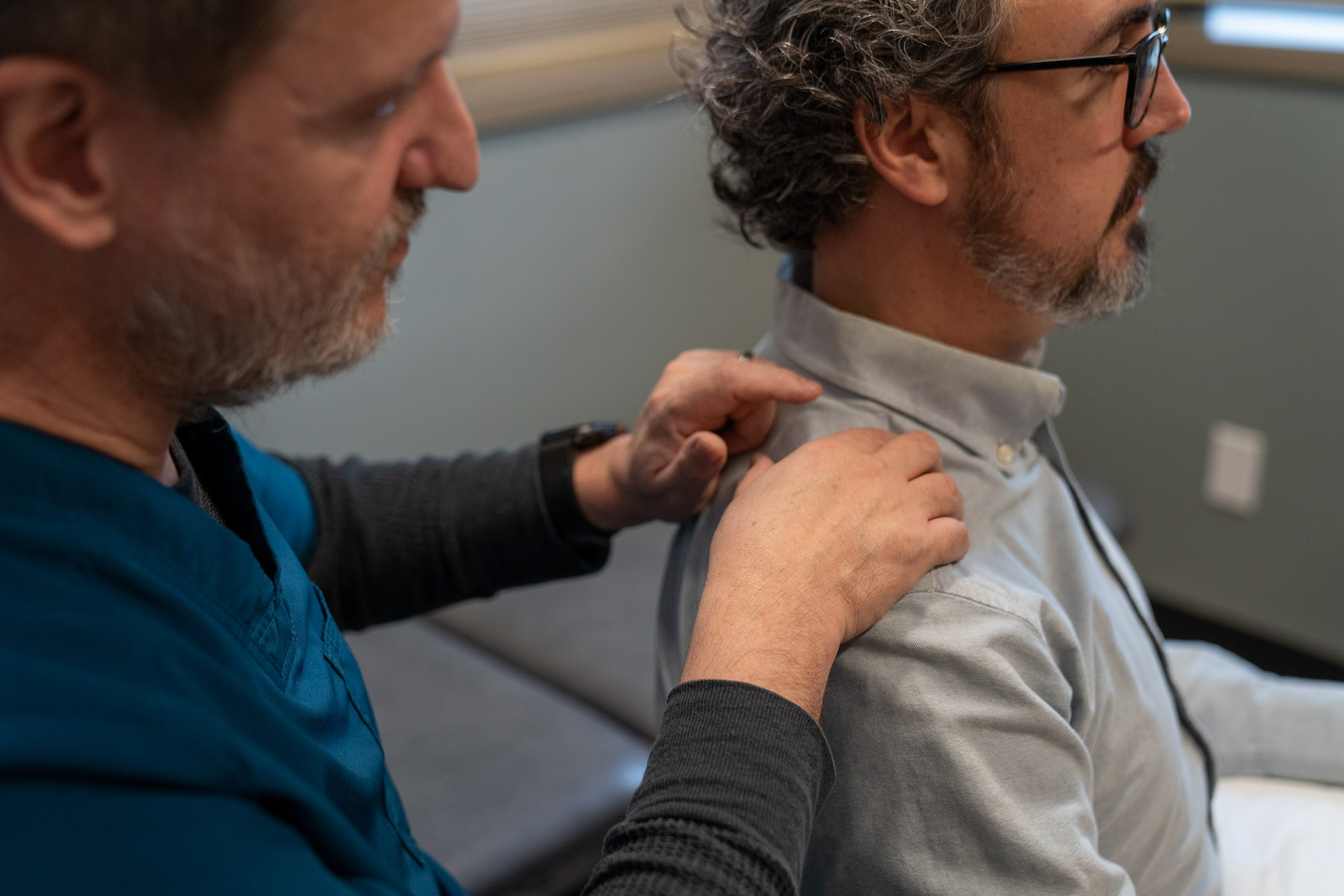
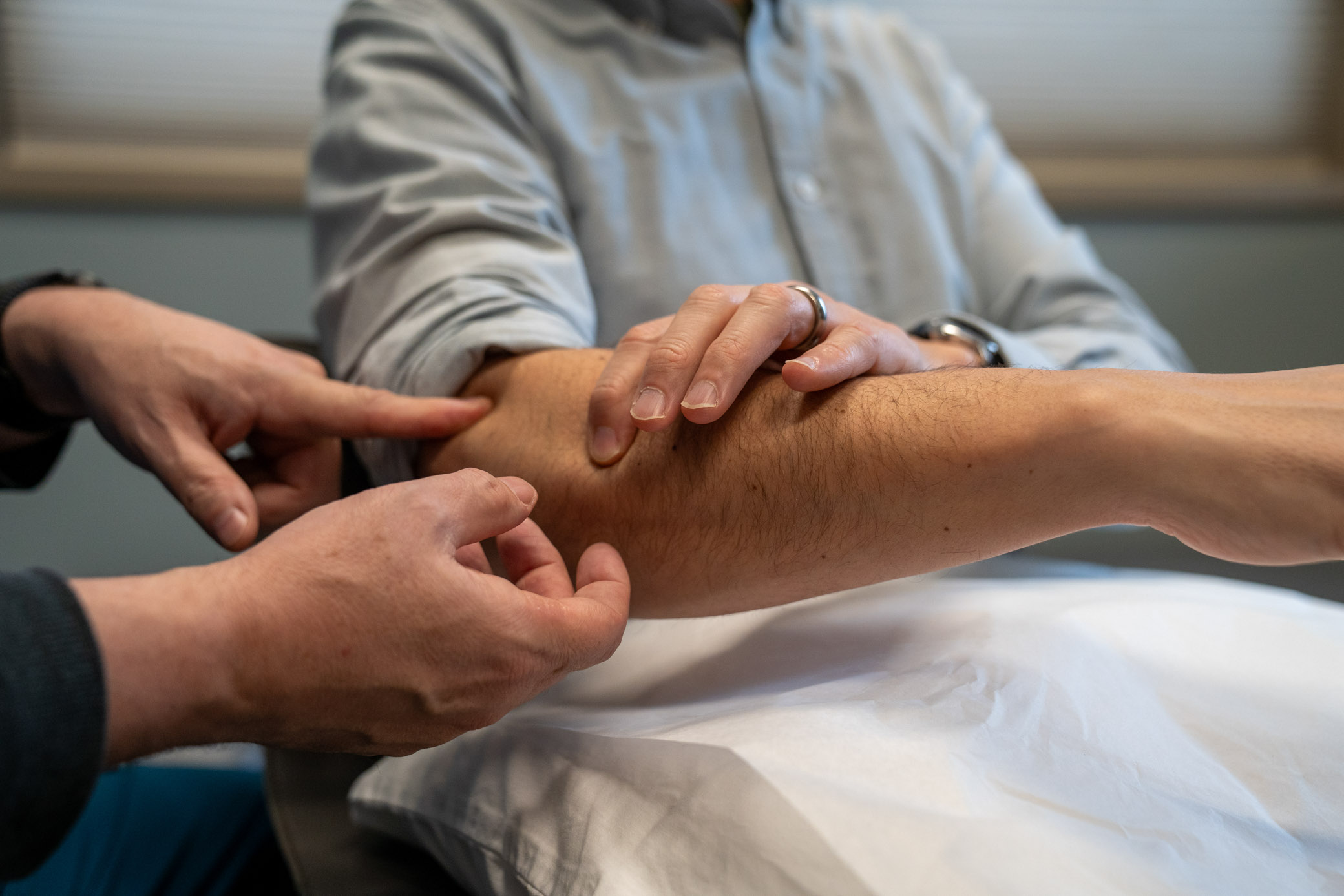
Sorting it out. Careful physical examination and sensory mapping tell me whether a symptom is a compressed nerve or a muscle referring pain. EMG and nerve conduction testing settles the question objectively when it matters. This is not academic: trigger point pain and radiculopathy feel identical to the person who has them, and they need completely different treatment.
Treating the Body leg. Trigger point injections with hydrostatic IMS, joint injections, and physical therapy coordinated around an accurate diagnosis.
Keeping the other two legs in view. Trauma-informed care for the alarm. Vestibular and oculomotor rehabilitation for the brain. I do not do all of that work myself, and I should not. What I do is make sure it happens, in the right order, and that nobody is handing you advice that contradicts somebody else's. How collaborative care works →
What to Do After a Car Accident in Washington
The days after a crash are confusing. Here is the sequence that protects both your health and your claim.
Get medically evaluated, even if you feel okay
Whiplash and concussion symptoms commonly appear or worsen 24 to 72 hours after a collision, once adrenaline fades. An early physician visit catches injuries before they compound and establishes the medical record that connects your symptoms to the crash.
Open a PIP claim with your auto insurer
If your policy includes Personal Injury Protection, call your insurance company and open a PIP claim. You will receive a claim number that lets medical providers bill your treatment directly, regardless of who caused the crash.
Start treatment guided by an accurate diagnosis
Effective recovery starts with knowing exactly what was injured: which joints, which muscles, which nerves, and how your nervous system is responding to the trauma. From there, treatment might include manual therapy, dry needling, targeted injections, and coordinated physical therapy.
Keep everything documented
Attend appointments consistently and report all symptoms, including the ones that seem unrelated like poor sleep, irritability, or brain fog. Gaps in care and unreported symptoms are the two most common reasons legitimate claims get disputed.
PIP Coverage: Treatment Without Out-of-Pocket Cost
Washington requires auto insurers to offer Personal Injury Protection, and most drivers carry it. PIP pays for reasonable and necessary medical treatment after a crash no matter who was at fault, typically starting at $10,000 in coverage and often more.
- No referral needed to see a physiatrist
- No copays or deductibles under most PIP policies
- Covers evaluation, EMG testing, injections, and coordinated therapy
- Applies to drivers, passengers, and often pedestrians and cyclists
Not sure whether you have PIP, or the other driver was at fault and you want to understand your options? Bring your questions to the first visit. We handle motor vehicle claims every day and can help you sort out the billing path.
L&I Claims Welcome Too
If your crash happened while driving for work, your injury may fall under a Washington L&I workers' compensation claim instead of PIP. Dr. Franke is an authorized L&I provider who consults on work injury claims and performs EMG testing for injured workers. Learn about work injury and L&I care →
A Medical Record That Tells the Whole Story
Insurance adjusters and attorneys read medical records with one question in mind: is there objective evidence connecting these symptoms to this crash?
As a board-certified physiatrist who performs and interprets his own electrodiagnostic studies, Dr. Franke produces exactly that kind of record: detailed examination findings, objective EMG data when nerve injury is suspected, and clear clinical reasoning connecting mechanism of injury to diagnosis.
If your case involves an attorney, we communicate with them at your request and provide narrative reports when needed.
Common Questions After a Car Accident
Do I need a referral to see a car accident doctor?
No. You can schedule directly. No referral from a primary care physician is required, and PIP coverage does not require one either.
Will my treatment cost me anything out of pocket?
If your auto policy includes Personal Injury Protection, it pays for reasonable and necessary medical care after a crash regardless of fault, typically with no copay or deductible. We bill PIP directly. If you do not have PIP, other options such as the at-fault driver's insurance or your health insurance are usually available, and we can help you sort out which applies.
How soon after a car accident should I see a doctor?
Ideally within the first several days. Symptoms often worsen 24 to 72 hours after a crash, and early evaluation improves recovery while creating the documentation your claim needs. That said, it is never too late to be evaluated, even months after a collision.
What is the difference between a physiatrist and a chiropractor after a car accident?
A physiatrist is a medical doctor specializing in physical medicine and rehabilitation. Dr. Franke provides medical diagnosis, EMG nerve testing, targeted injections, prescriptions, and imaging orders, and coordinates care with chiropractors, physical therapists, and massage therapists. Many patients do best with both working together from a shared diagnostic picture.
Do you work with personal injury attorneys?
Yes. We provide objective electrodiagnostic findings, thorough chart documentation, and narrative reports, and we communicate with attorneys handling motor vehicle claims when patients request it.
Why See a Physician After a Car Accident
Most crash injuries do not show up on X-rays. Whiplash, concussion, nerve irritation, and deep muscle injury are diagnosed by careful physical examination and, when needed, electrodiagnostic testing. Dr. Kelvin Franke is a board-certified physiatrist, a medical doctor whose entire specialty is diagnosing and treating exactly these injuries.
Medical Diagnosis
A physiatrist can order imaging, prescribe medication, perform targeted injections, and document your injuries in the medical record your insurance claim depends on.
Objective Nerve Testing
EMG and nerve conduction studies provide objective evidence of nerve injury that imaging misses, distinguishing radiating arm or leg pain from local muscle injury.
Coordinated Care
Recovery works best when your chiropractor, physical therapist, and massage therapist work from one medical diagnosis. Dr. Franke coordinates that team.
Getting Here
We are at 7631 212th St SW, Suite B-105, Edmonds, WA 98026, directly across 212th from Edmonds-Woodway High School. Map, site plan, and step-by-step directions.
Parking and access
Free surface parking on site, with the entrance at ground level. No stairs, no parking garage, and no elevator to find. That matters more than it sounds when your neck will not turn and you are already in pain.
Finding us
The clinic sits just off Highway 99 on 212th St SW, a few minutes from I-5. Two driveways lead in from 212th, one on each side of the gazebo. Look for the central octagonal building; we are the suite immediately to its left, under the red metal roof, with B-105 on the glass of the door.
After a crash, come early
You do not need a referral and you do not need to wait for an adjuster. Washington PIP covers medical care regardless of who was at fault, and the sooner an injury is documented, the cleaner both your recovery and your claim will be.
Formerly in Lynnwood
Our Lynnwood office closed in October 2026. If you were a patient there, nothing else changes: same physician, same records, same phone number. Please replace the old address if it is saved in your phone or your insurer's file.
Serving: Edmonds, Lynnwood, Mountlake Terrace, Shoreline, Woodway, Brier, Esperance, and the surrounding Snohomish and North King County communities.
Start Your Recovery
New patient visits are scheduled for a full hour: enough time for an accurate diagnosis, a treatment plan you understand, and a medical record that documents what actually happened to your body. PIP and L&I accepted. No referral needed.